1. Getting a higher education is expensive.
2. The jobs available with the higher education don't pay enough to get you out of debt.
I'll be the first to decry the ridiculous tuition costs most universities charge, but let's examine that first argument. To preface my argument, we need to remember something:

Harvard University, a name that is almost synonymous with higher education in the United States, declares that it is "devoted to excellence in teaching, learning, and research, and to developing leaders in many disciplines who make a difference globally." Let's dissect that statement. "Excellence" is defined as "a talent or quality which is unusually good and so surpasses ordinary standards." The National Board for Professional Teaching Standards (NBPTS) for teaching are as follows:

So, now that we know what the standards are, we have a better idea of what "excellence" Harvard is talking about. As long as Harvard is exceeding, can anyone gripe that they are not fulfilling their end of the bargain? They said they would deliver X product for Y tuition. I don't think anyone can argue that Harvard is not turning out "leaders in many disciplines who make a difference globally" when they boast these people as graduates. 
The last word is communities. Their site layout is wonky.
In exchange, Harvard charges about $46,000 per semester.
At this time, I invite you to go re-read The Joker's advice.

Getting a Harvard education is expensive. No one's arguing that point. What people seem to be unhappy about is that, armed with a diploma, the jobs available make it impossible to live at the graduate's desired level of comfort and pay off their loans.
There are a couple of a elements to the equation then.
1. Desired lifestyle
2. Amount of debt.
3. Amount of income
From where I stand, it then makes sense to take your tuition dollars to a university that gives you a good ratio of the three. If that's Harvard, kudos to you. If it's University of Phoenix, that's fine too. I've known Ivy League grads and community college kids, and they were all in pretty good places in their career. One of my mentors when I was a teen graduated from a small community college out west and, after working for a three-letter government agency now holds an important position in a globally-recognized energy company. Not bad for less than $30,000 in tuition.
I'm frustrated because I see lots of people complaining that education is costly and jobs don't pay much. I think we need to remember that education does not always equal high income. Archeologists are very educated people but get paid pennies. We're all familiar with teachers who are incredibly smart and good at what they do and get paid poorly.
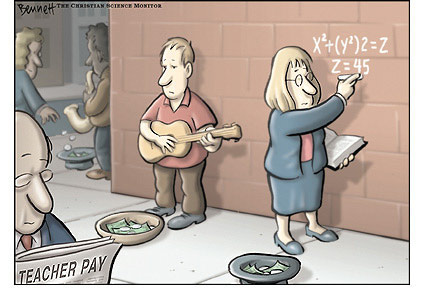
The issue is, no college has ever promised "Earn our degree to make $150,000/year!" They just say that they'll teach you enough about biology or chemistry or political science to bestow a bachelor's degree on you. If a business requires you have that degree in order to be hired, that's not really a concern to the college. They're in the business of bestowing degrees. Businesses are in the business of hiring employees with skills or knowledge to earn the company money. You are in the business of knowing enough to do a job worth X dollars a year. You get to fill in the X.
If you think you're paying too much in tuition, then go somewhere that's more in your budget. That's a no-brainer. If you think your degree will not land you the income you want, then you should learn a skill or earn a degree that will.
But the real point that we seem to be missing is that universities exist to teach people how to think. It wasn't until about 900 years ago that universities starting teaching skills that related to jobs (and that's only because guilds and corporations were sponsoring the university to do so)
I can really only speak on my personal experience. I went to two universities, one private, one public. They cost roughly the same; about $2,300 per semester. While I did take out a student loan, the majority of my tuition was paid by my parents (~$9,000) and Federal Pell Grants (~$15,000).
At this point, you might cry foul at my position in this post. Sure, it's easy for me to tell people not to complain; my education was paid for. I'm very grateful that my parents spent money on me that they earned for themselves. We can get into a discussion of parental responsibilities and love, but the fact is, they shelled out a lot of cash to get me an education. After I graduated, I helped a few others with their college expenses and plan to continue to do so. As far as Pell Grants go, I'm not special. Lots of people can get those, and it makes financial sense for the government to offer those. In the job I work (which I could only get with a college degree) I will have repaid my Pell Grants in the form of income tax with the first year or two of post-grad employment. And then I will continue to pay those taxes for the next 40 years. My college degree was one of the best investments Uncle Sam ever made.

At the end of the day, we live in a capitalistic nation. Schools get to charge whatever they want. If they charge too much, students stop going there and the school either closes or lowers its tuition. Adam Smith's unseen hand guides American education just as much as it does the marketplace.

No comments:
Post a Comment