A friend asked if I had any advice on writing for her students. This was my very overdue response:
Write always. Carry a pen and a notebook around you. My workspace is full of sticky notes and napkins and scraps of paper that I've written ideas on. It's absolutely vital that you're ready to write these flashes of brilliance down when they come to you.
WRITE DOWN EVERYTHING.
Never, ever, absolutely ever, never compare your writing to anyone else's. You are not in the business of the being a J.K. Rowling or a Stephen King or a Stefanie Meyer. That's their job. Your job is to do YOUR kind of writing.
READ EVERYTHING. Absolutely inhale books. To create good muscles, you have to exercise lots. To create good books, you have to read lots.
Do it. I became a professional writer because I was tired of writing stuff at home in my room for free. I found an ad online and starting writing for them, and then starting approaching clients, and then clients came to me, and then I started writing for a magazine, and a newspaper, yadda, yadda yadda. No one is going to break into your room and read your amazing novellas. You have to stick your hand out in the universe if you want someone to read your writing.
To be a writer, all you have to do is write. to be an AUTHOR, someone needs to read your work. So, put it everywhere. Put your work on Facebook. Put it on your blog. Put it on the bathroom stall. Put it on the sidewalk in front of your friend's house.
NEVER throw away or delete your writing. That story idea may fit into another one ten years later. That snappy bit of dialogue that had no home in 4th grade will be perfect for that bit you write in college. Past writings, no matter how horrible you think they are, are fantastic footprints to show you how far you've come. I was reading a book that I had written and published two years ago. I mean, come on, that's the pinnacle of writing, right? And all I could think was "ick, did I really write that AND submit it?" and at the same time, you can look at something you wrote a decade ago and think "dang, that is GOOD." Never ever get rid of your old writing. Stick it in a folder in the back of your closet if you can't stand to look at it, but don't get rid of it.
This is a tough one: be willing to destroy your work. This doesn't mean burn all your old, horrible writings. This means that you need to be ready to delete that description of the old car, or admit that your favorite side character really doesn't have a place in this scene, or this story. The ink that flows from your fingertips is not always gold. Some stuff doesn't have a place in your current project and shouldn't be there. (that doesn't mean it won't be super handy when you're 45)
Realize that writing can be a pastime, a job, or a hobby. You don't have to be a best-seller unless you want to be. Pick the level of involvement you want, and don't feel pressured to be more or less than that. Regardless, realize that you are developing an incredible skill that will serve you well. You will write papers in school. You will write letters to future employers who you are trying to convince to pay you lots of money and give you dental insurance. Being able to write well--especially in the age of near-illiteracy that the Internet breeds--makes you a gladiator among barbarians.
Writing words means you're communicating. Literally, you're taking an intangible idea from inside your head and with a few scribbles you are installing that idea in another person's brain.
THAT. IS. INCREDIBLE.
Thursday, November 21, 2013

Friday, October 18, 2013
Test-Taking Anxiety
I got slaughtered on my Spanish exam. I went in feeling very B-ish about it, and came out with a Chudley Cannons' motto-like apprehension. A week later, I got my test back with a big red 70 scribbled across the top.

Using all the tactics taught to me by parents and eight siblings who had maneuvered through the halls of public school before me, I went to see my professor and go over the test, so I can (hopefully) do better on the next one. As we went through, question by question, I explained that I had known some of the vocabulary and grammar before the test, but forgot it in the moment. He turned to me with a wary look in his eye and cautiously asked:

Walking out of the Liberal Arts Building at my university, I couldn't help but think of a woman I knew in Oregon. "I can't work," she told me matter-of-factly. "Being around people stresses me out." Her unemployed husband nodded in agreement.
If taking tests stresses me out, can I skip out on them? If going to work makes me uphappy, can I expect someone else financially support me? In short, if I don't like a situation, what rights do I have in removing unpleasantness from my life? 'Cause I'm really sick of the government taking 20% of my income, my landlord insisting I clean up after myself, my school refusing to give me a diploma unless I earn high enough marks, and the police insisting I not assault stupid, offensive people.

All these things stress me out...so can I get some extra considerations in this Test?

Using all the tactics taught to me by parents and eight siblings who had maneuvered through the halls of public school before me, I went to see my professor and go over the test, so I can (hopefully) do better on the next one. As we went through, question by question, I explained that I had known some of the vocabulary and grammar before the test, but forgot it in the moment. He turned to me with a wary look in his eye and cautiously asked:
"do you have test-taking anxiety?"
The first response to careen around my cranium was "oh please, not another feel-good socio-psycho phenomenon of my coddled generation." My second thought was "Is that a thing?"

Instead of firing that off though, I replied with something like "no more than the next person," and we went on reviewing my mistake-ridden test.
Is test-taking anxiety real? Or rather, I mean "is taking tests agonizing enough that we ought not to do it? Is the strain, stress, etc of this style of knowledge-testing worth inflicting on young students?
As my political analysis teacher so well explained, tests allow us to quantify as best as possible how well someone has internalized taught knowledge. None of us like to sit down and bubble in circles with a No. 2 pencil: there are plenty of stereotypical characters that embody our self-doubt concerning standardized test performance.

As I left my professor's office, I wondered: at what point are the standard stressors of life no longer acceptable. When does our Irish-inspired hardiness to accept the hardships of life and deal with them stop and our unacceptance of unpleasantries begin? And when should it?
"I’ve learned all our course books by heart, of course.”
Walking out of the Liberal Arts Building at my university, I couldn't help but think of a woman I knew in Oregon. "I can't work," she told me matter-of-factly. "Being around people stresses me out." Her unemployed husband nodded in agreement.
If taking tests stresses me out, can I skip out on them? If going to work makes me uphappy, can I expect someone else financially support me? In short, if I don't like a situation, what rights do I have in removing unpleasantness from my life? 'Cause I'm really sick of the government taking 20% of my income, my landlord insisting I clean up after myself, my school refusing to give me a diploma unless I earn high enough marks, and the police insisting I not assault stupid, offensive people.

All these things stress me out...so can I get some extra considerations in this Test?
Saturday, September 7, 2013
The Lone Ranger and His Many Issues
I saw The Lone Ranger last night. I paid $6 for me and my date, but I also gave up 2 hours and 29 minutes of my life, so now I'm going to say a few things.
First off, the movie is terrible. And offensive. And dumb. Whatever suspenders were holding my disbelief in check snapped within the first 10 minutes. While the issues with this film are legion, I'll focus on three themes in the movie.
Justice/Morality/Ideology
Armie Hammer's, who plays the titular character John Reid, very first line of the movie is "This is my religion," stated to an old Presbyterian woman who invites him to worship with her. As he says this, he holds up a copy of John Locke's Two Treatises of Government. John Reid, new district attorney for Colby, Texas, is obviously a studious dude, too intellectual to fall for hokey religions, and only needs Locke to tell him how to live. (He conveniently doesn't mention the sections on the justification of slavery and the rights of conquerors in Treatises).
As soon as he gets into town, DA Reid runs into his ex-girlfriend, Rebecca, who broke up with him eight years earlier and married his brother, Dan.


So, the Religious Moral of the story is: Christians are bland, boring people who don't like sex and whiskey, but especially don't like Jack Sparrow in war paint.
Let's contrast this with some personal facts from my family. My great-great grandfather, Levi Savage, traveled across the plains in 1847 to Utah. When the Mexican War broke out, he enlisted, then went on to Utah, before travelling to Siam to preach Christianity there. However, since the French and the Siamese were banging it out, he went to Burma and India, eventually travelling all the way around the world.
Also, his wife died crossing the plains, so he raised their son by himself until he remarried. Boo-yah.

Frumpy? No. Levi had three wives. Elderly? He was 33 when he circumnavigated the globe, but he lived until he was 90, journaling regularly in a diary that is widely regarded as one of the finest and most detailed accounts of the Mormon migration.
Hellfire? Nope. He taught this.
As for hating the Indians, another of my Old West ancestors had a group of Indians with a baby they had stolen from another tribe come to her home. They were attempting to trade the baby for goods, and said they would kill the baby girl if no one traded with them. My great-great-grandmother gave them a few things in a flour sack, and raised the baby as her own.
Now Nate, that's cool and all, but The Lone Ranger isn't about Christians enduring hard stuff in the name of their religion. It's about lawmen and outlaws on the frontier!
Let's examine my other great-great-grandfather, John D. T. McAllister.

Like Levi, he went on a religious mission (to Belfast, Ireland) in 1853, then helped organize the hand cart companies in Iowa for the trek west. Once he got to Utah, he was elected Utah Territorial Marshall, the top law enforcement officer for Utah Territory from 1863-1866, and was also elected the Salt Lake City Marshall, a position he held from 1869 until 1876. My family still has the gun he carried and the badge he wore. While he was doing all this, mind you, he was practicing his religion, and (for my Mormon readers) was in the temple presidencies of the St. George and Manti temples.
So no, Disney. Christians didn't cower in the corner harassing sinners while the jaded-but-handsome cowboys won the West. They were bringing order to chaos, buildings settlements, discovering gold in California, irrigating the desert, and basically building the country.
The Lone Ranger gets his name, not from working alone, but because he is (supposedly) the only surviving Ranger after his brother's 8-strong posse gets killed. As of 1857 (granted, 12 years before the movie is set), there was something like 100 Texas Rangers. So apparently the other 92 all died at Gettysburg or were off doing real law enforcement while John Reid is playing cowboy.
Promontory Point, where the transcontinental railroad is completed--and the final scene of the movie takes place--is not in Texas. (Because Texas totally has red-rock canyons and mountains covered in pine trees) IT'S IN UTAH. Over 1,000 miles away.


More than 1,000 miles. That's like having Tom Hanks announce "Okay men, it's D-Day. Get read to invade Portugal."

The Comanches never attacked settlements. FALSE. However, it wasn't as prevalent as westerns would make you believe. There was the Buffalo Hunters' War in 1877. The Comanche were ticked that hunters were still going after buffalo, so they left the reservation and shot up a bunch of hunting outposts. Five hunters and something like 35 Indians were killed.
Scalping occurs in the movie, where white men dress up as Indians and attack farms to misdirect blame. I can only surmise that Disney, Gore, and Jerry are playing up the idea that colonists were the ones who introduced scalping to the Native Americans, not the other way around. However, evidence of scalping exists extensively in human remains on the North American continent, dating back to 1325, long before European settlers arrived.
I realize Hollywood has never been big on reloading. Still, I counted as the Lone Ranger fired 10 shots out of his six-shooter before he pulled a second gun. His opponent in the duel fired more than 22 bullets from two guns in less than 9 seconds. I'm not a math teacher, but...

So, the Realism Moral of the movie is: It doesn't matter that your public school education isn't teaching you anything useful, kids, because you can move landmarks, change historical events, defy physics, and invent whatever facts you need!
First off, the movie is terrible. And offensive. And dumb. Whatever suspenders were holding my disbelief in check snapped within the first 10 minutes. While the issues with this film are legion, I'll focus on three themes in the movie.
Justice/Morality/Ideology
Armie Hammer's, who plays the titular character John Reid, very first line of the movie is "This is my religion," stated to an old Presbyterian woman who invites him to worship with her. As he says this, he holds up a copy of John Locke's Two Treatises of Government. John Reid, new district attorney for Colby, Texas, is obviously a studious dude, too intellectual to fall for hokey religions, and only needs Locke to tell him how to live. (He conveniently doesn't mention the sections on the justification of slavery and the rights of conquerors in Treatises).
As soon as he gets into town, DA Reid runs into his ex-girlfriend, Rebecca, who broke up with him eight years earlier and married his brother, Dan.

(In hindsight, putting on a mask and hanging out with a mentally ill
Native American isn't all that bad of a way of rebounding.)
However, it's obvious they've still got the hots for each other, so Dan hangs around awkwardly while they oogle each other. Rebecca gets mad that Dan is running off to chase bad guys again. Then, the menfolk leave to go catch the bad guys, cause that's what they did back then.
Throughout the movie, John Reid, the Lone Ranger, refuses to shoot anyone, especially the villain. By my count, at least 12 people die because John won't shoot Cavendish any of the THREE TIMES he has the chance to. Finally, John jumps off a crashing train in the nick of time to save himself, but taunts Cavendish as he is ripped apart by the train (conveniently not shown). So the Non-Violence Moral is that's it's bad to shoot people, but ensuring they're unable of escaping elaborate, deadly traps is okay. In case you missed the moral with Cavendish, Tonto kills Latham Cole--the poster child for Evil Capitalism--in the same way a few minutes later.
Later, John jumps from the train and makes out with Rebecca while simulating sex on a horse.
No, you read that right.

Y'know...for kids!!
At the end of the movie, the Lone Ranger gets ready to ride off and chase bad guys. He tells Rebecca he can't stay, in a scene that mirrors Dan telling her the same thing from the start of the film. Rebecca smiles and says she understands, but if he ever wants a FWB, to look her up.
So, the Morality Moral of the story is: your sister-in-law is fair game, as long as you wait until your brother is murdered and you let the killer go. Also, you don't need to commit or help her raise her son. Since her hired hand got scalped and you drown the man who offered her marriage, it's a cinch she'll be just fine on the 1870's frontier.
Also, the Lone Ranger has an fireside epiphany that if TWO of the guys on the frontier are corrupt, then he no longer wants to represent the law. So, he breaks up with Locke and goes vigilante. This results in him forcing a US Army soldier to shoot a bunch of his squadmates, pistol-whipping a restrained prisoner, and arranging fatal "accidents" for the villains.

So, the Justice Moral is: actually, individuals don't have to surrender personal sovereignty in exchange for communal government, but rather can ignore nature's demand for order--since Locke's laws of nature are based on there being a divine power that governs the universe--and you can pretty much do whatever you and your six-shooter can dream of.

"Do you believe in the nullification of the social contract in exchange
for individualistic anarchy? Well, do ya?"
Religion
The topic of religion is breached in one of the first scenes, where a dapper John Reid sits in a train car amidst a group of Presbyterians, all of them frumpy elderly women, one young girl, and a wild-eyed preacher, whose only lines are to call down hellfire and archetypal Christian hypocrisy. Later, the preacher takes a break from his Bible-thumping to lead a literally-torch-carrying mob into a whorehouse to kill Tonto the Indian.So, the Religious Moral of the story is: Christians are bland, boring people who don't like sex and whiskey, but especially don't like Jack Sparrow in war paint.
 |
| A face only a critic could love? |
Let's contrast this with some personal facts from my family. My great-great grandfather, Levi Savage, traveled across the plains in 1847 to Utah. When the Mexican War broke out, he enlisted, then went on to Utah, before travelling to Siam to preach Christianity there. However, since the French and the Siamese were banging it out, he went to Burma and India, eventually travelling all the way around the world.
Also, his wife died crossing the plains, so he raised their son by himself until he remarried. Boo-yah.

Levi Savage, 1895, age 75
Frumpy? No. Levi had three wives. Elderly? He was 33 when he circumnavigated the globe, but he lived until he was 90, journaling regularly in a diary that is widely regarded as one of the finest and most detailed accounts of the Mormon migration.
Hellfire? Nope. He taught this.
As for hating the Indians, another of my Old West ancestors had a group of Indians with a baby they had stolen from another tribe come to her home. They were attempting to trade the baby for goods, and said they would kill the baby girl if no one traded with them. My great-great-grandmother gave them a few things in a flour sack, and raised the baby as her own.
Now Nate, that's cool and all, but The Lone Ranger isn't about Christians enduring hard stuff in the name of their religion. It's about lawmen and outlaws on the frontier!
Let's examine my other great-great-grandfather, John D. T. McAllister.

Like Levi, he went on a religious mission (to Belfast, Ireland) in 1853, then helped organize the hand cart companies in Iowa for the trek west. Once he got to Utah, he was elected Utah Territorial Marshall, the top law enforcement officer for Utah Territory from 1863-1866, and was also elected the Salt Lake City Marshall, a position he held from 1869 until 1876. My family still has the gun he carried and the badge he wore. While he was doing all this, mind you, he was practicing his religion, and (for my Mormon readers) was in the temple presidencies of the St. George and Manti temples.
So no, Disney. Christians didn't cower in the corner harassing sinners while the jaded-but-handsome cowboys won the West. They were bringing order to chaos, buildings settlements, discovering gold in California, irrigating the desert, and basically building the country.
Realism
I know it might be dumb to complain about historical inaccuracies in a movie based on a lawyer coming back from the dead, but some things have to be straightened out.The Lone Ranger gets his name, not from working alone, but because he is (supposedly) the only surviving Ranger after his brother's 8-strong posse gets killed. As of 1857 (granted, 12 years before the movie is set), there was something like 100 Texas Rangers. So apparently the other 92 all died at Gettysburg or were off doing real law enforcement while John Reid is playing cowboy.
Promontory Point, where the transcontinental railroad is completed--and the final scene of the movie takes place--is not in Texas. (Because Texas totally has red-rock canyons and mountains covered in pine trees) IT'S IN UTAH. Over 1,000 miles away.

"Kemosabe, we have no jurisdiction here. Let's go back to Texas."
More than 1,000 miles. That's like having Tom Hanks announce "Okay men, it's D-Day. Get read to invade Portugal."
 |
"Don't worry boys. Matt Damon will issue you all copies of Rosetta Stone Portuguese."
|
However, given that almost all of The Lone Ranger was shot in Utah, I guess the producers thought "hey, we should use this cool landmark; we'll just pretend it's in Texas." I realize I may be setting my standards too high; these are the same guys who thought Nicholas Cage would make a good action hero.

The Comanches never attacked settlements. FALSE. However, it wasn't as prevalent as westerns would make you believe. There was the Buffalo Hunters' War in 1877. The Comanche were ticked that hunters were still going after buffalo, so they left the reservation and shot up a bunch of hunting outposts. Five hunters and something like 35 Indians were killed.
Scalping occurs in the movie, where white men dress up as Indians and attack farms to misdirect blame. I can only surmise that Disney, Gore, and Jerry are playing up the idea that colonists were the ones who introduced scalping to the Native Americans, not the other way around. However, evidence of scalping exists extensively in human remains on the North American continent, dating back to 1325, long before European settlers arrived.
I realize Hollywood has never been big on reloading. Still, I counted as the Lone Ranger fired 10 shots out of his six-shooter before he pulled a second gun. His opponent in the duel fired more than 22 bullets from two guns in less than 9 seconds. I'm not a math teacher, but...

Six. Just six.
So, the Realism Moral of the movie is: It doesn't matter that your public school education isn't teaching you anything useful, kids, because you can move landmarks, change historical events, defy physics, and invent whatever facts you need!
In Closing
They got the history wrong. They got the physics wrong. They got the dialogue wrong. They got the Indians, the Christians, the Army, the Railroad, and the lawmen wrong. It's a badly made movie, from a filmmaking perspective. Our only hope is that this movie will hobble off into the sunset licking it's poor performance wounds and pointing fingers at everyone else. Disney's got enough Marvel heroes and Star Wars sequels to keep itself busy. Let's leave the Lone Ranger to its plethora of problems and not create a sequel ever.
Friday, September 6, 2013
My Male Celebrity Crush
Someone asked me a long time ago who my male celebrite crush was. It's a dumb, pedantic, harmless question, but I didn't respond because a) I'm against favoritism, b) I'm not into guys, and c) again, it's a dumb, pointless question. However...
I gotta say Jack White.


It's not solely that he dated a hot crazy chick and he and I would have a lot of common ground to talk about.

It's not solely because he verbally b*slapped Lady Gaga.
It's partially because of his approach to a) music, and b) life. Below is his response to a question about his music.
"...It's all the intracacies of how people relate to each other and how sometimes we sabotage each other; we sabotage ourselves. We hurt ourselves to get something better. What do we all want love for in the first place? If we want love so much, like everybody does, why do we do the things that we do, to hurt one another so much?"
It's partially because of his old-timey style.

He contributed to the Great Gatsby soundtrack, which certainly didn't lose him any points with me.
But I think what really clinches him as my male celebrity crush is that he's kind of been a blueprint of my inner rocker.
He started off playing guitar after work in the back room of an upholstery store. He kept playing, didn't matter with who (like Del Paxton told us), until he made it big. And frankly, he hasn't changed much of who he is from then 'til now. A lot of Jack's music is very spiritual, especially the Get Behind Me, Satan album, and my personal favorite "Catch Hell Blues."
Jack White's dabbled in film, played a lot of music, and basically been a solid guy who appreciates his backing musicians, sound guys, and fans. It's hard to find an unpretentious celebrity. So, he gets my vote.
Rock on, Jack, rock on.
I gotta say Jack White.
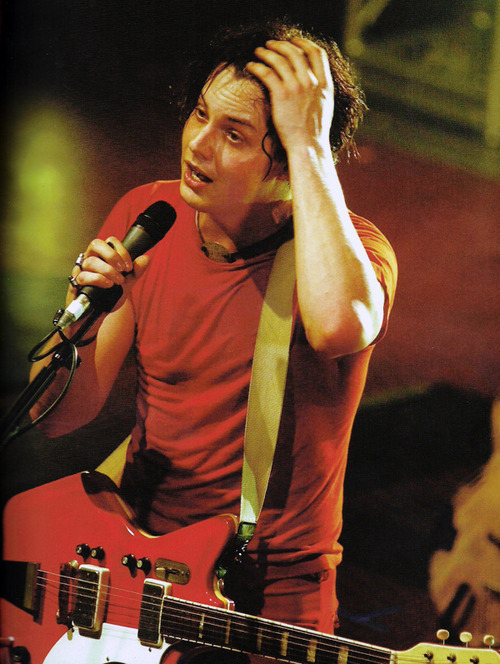
This is not solely because "Seven Nationa Army" is an amazing rock anthem of my formative years, nor because that's my song on Rock Band, that I tend to sing note-for-note while wandering around my apartment while my friends play back-up in the living room.

It's not solely because he verbally b*slapped Lady Gaga.
It's partially because of his approach to a) music, and b) life. Below is his response to a question about his music.
"...It's all the intracacies of how people relate to each other and how sometimes we sabotage each other; we sabotage ourselves. We hurt ourselves to get something better. What do we all want love for in the first place? If we want love so much, like everybody does, why do we do the things that we do, to hurt one another so much?"
It's partially because of his old-timey style.
He contributed to the Great Gatsby soundtrack, which certainly didn't lose him any points with me.
But I think what really clinches him as my male celebrity crush is that he's kind of been a blueprint of my inner rocker.
He started off playing guitar after work in the back room of an upholstery store. He kept playing, didn't matter with who (like Del Paxton told us), until he made it big. And frankly, he hasn't changed much of who he is from then 'til now. A lot of Jack's music is very spiritual, especially the Get Behind Me, Satan album, and my personal favorite "Catch Hell Blues."
Jack White's dabbled in film, played a lot of music, and basically been a solid guy who appreciates his backing musicians, sound guys, and fans. It's hard to find an unpretentious celebrity. So, he gets my vote.
Rock on, Jack, rock on.
Saturday, August 3, 2013
The Office: Part II
As some of you know, I don't like to follow trends. I ignored Harry Potter for 8 years just because everyone else thought he was the bee's knees. And so, because of this hipster vein in me--and because I wait until I can Netflix or pirate shows before I watch them--I just finished Season 9 of The Office.
I've talked about The Office before on here, so maybe this won't seem like anything new. You've probably heard me say, as I often have, "Man, I want a job like that; where I get paid and no one cares if I work."Seven years after I first saw the show and 12 years after it first aired, the story of Dunder Mifflin ends. And with it's end, I can officially say that I now have a legitimate office job; my very first. I work 8-5. I try to climb the ladder. I play pranks on that sci-fi nerd who despises me. I flirt with the cute girl.
It's rare that we have see films, books, television shows and other media forms that emulate real life. If we wanted real life, we'd look at our day. The fact that we're watching TV says that we're dissatisfied with our life. To paraphrase Sven Birkerts, "to [watch a TV show] voluntarily is at some level to remark the insufficiency either of one’s life or one’s orientation toward it." And yet, The Office is made up of humdrum, everyday experiences.
But that's what makes life so beautiful, right?
In the finale of Season 9, Jim and Pam talk about seeing the films of their lives; how they wish they could have talked to their past selves and given them the knowledge they know have, knowledge gained from living. The pixels of everyday life make amazing footage.
This is a personal blog, so what does this mean for me? Like Season 9 Pam wishes she could tell Season 2 Pam, you could be so much happier if you would let yourself be. My life's not perfect right now, but neither was Oscar's when Michael outed him, or Jim's when he left Athlead, or Meredith when everyone thought she was a deadbeat. Why should I let a few disheartening plot twists stop me from enjoying this amazing story of my life? I'm the main character!!
The Office has given me an amazing amount of hope and courage. When I have rough days at the office, I can come home and commiserate with Plop and Erin, or Kevin and Phyllis. When I worry about my future, I can remind myself that I'm only in Season 3 of my story. There's a lot more to come.

That's what she said.
Friday, March 29, 2013
Patronus Suspiciatus
Uncle Vernon died today.
Personally, I suspect Harry.
There. I said it.
We were all thinking it, and don't pretend you weren't.

Personally, I suspect Harry.
There. I said it.
We were all thinking it, and don't pretend you weren't.

Tuesday, January 22, 2013
Facebook Releases Killer Rabbit
Voila.
A fun piece for my favorite company.
http://inkdcontent.com/blog-m/archive/98-facebook-graph-search-killer-rabbit
A fun piece for my favorite company.
http://inkdcontent.com/blog-m/archive/98-facebook-graph-search-killer-rabbit
Monday, January 21, 2013
Nay, I Have Not Perished
The simple truth is, I didn't write much this summer because I was woe-is-meing my way through the sunny months. Then fall came and I was working 40-60 hours a week in addition to school. But never fear! Spring has sprung, and I'm down to only 4 jobs, an internship, and 12 credit hours. Piece o' cake.
I'm taking an honors creative writing class this semester which has got me writing creatively again. While I still like the benefits of commercial writing, I still like being able to tankas about dipthongs and lyrical poetry about loss and longing. I should probably take a page out of my own book and work on building up this blog's traffic, so without further ado...
A New Post is Coming! It's about Facebook's latest move, and involves lots of killer bunny jokes.

Now you've got to read it, right?
I'm taking an honors creative writing class this semester which has got me writing creatively again. While I still like the benefits of commercial writing, I still like being able to tankas about dipthongs and lyrical poetry about loss and longing. I should probably take a page out of my own book and work on building up this blog's traffic, so without further ado...
A New Post is Coming! It's about Facebook's latest move, and involves lots of killer bunny jokes.
Now you've got to read it, right?
Subscribe to:
Posts (Atom)